AI children's books in 2026: An honest overview of the services out there
A review of the most popular AI children's book services in 2026 — what they offer, what they're good at, and who they're best for.
There's something special about a children's book that's about your child specifically. When your kid is suddenly the hero of their own story — recognizing themselves, their pet, and their favorite places between the pages — something magical happens at reading time. And now, thanks to artificial intelligence, anyone can create books like these — without being a writer or an illustrator.
But with more and more services popping up, it can be hard to know what's actually out there. This article takes a thorough look at the most popular AI children's book services in 2026 — what they offer, what they're good at, and who they're best for.
Full transparency: We built Fanteri, so we naturally have our own perspective. We've done our best to give a fair overview — and we believe there's room for everyone working to make reading time a little more magical.
Fanteri
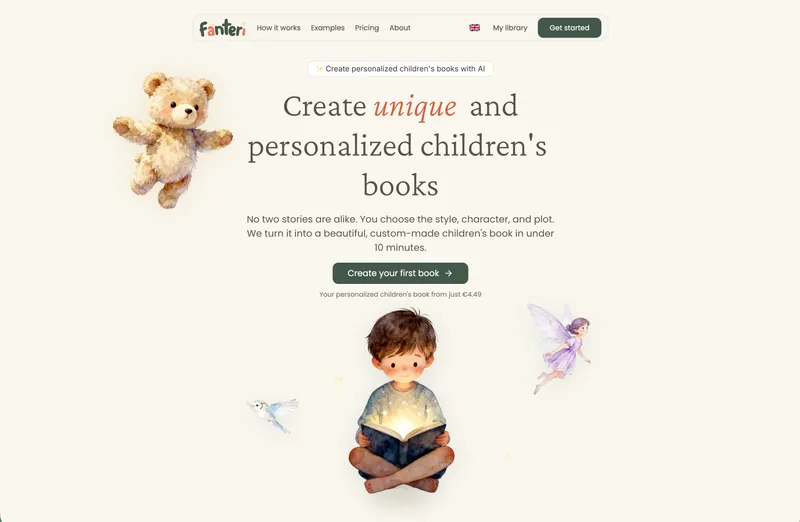
Fanteri is a Norwegian service where parents decide everything — not just the name and appearance, but the story itself. You choose the style, character, and plot, and the AI writes a completely unique story based on your ideas, tailored to your child's age.
What they're good at
What sets Fanteri apart from most other services is the illustrations. Each page is a full-bleed spread — one large, continuous illustration stretching across both pages, with text elegantly placed on top of the image. This gives the books a professional, picture-book quality that stands apart from services where text and images live on separate surfaces.
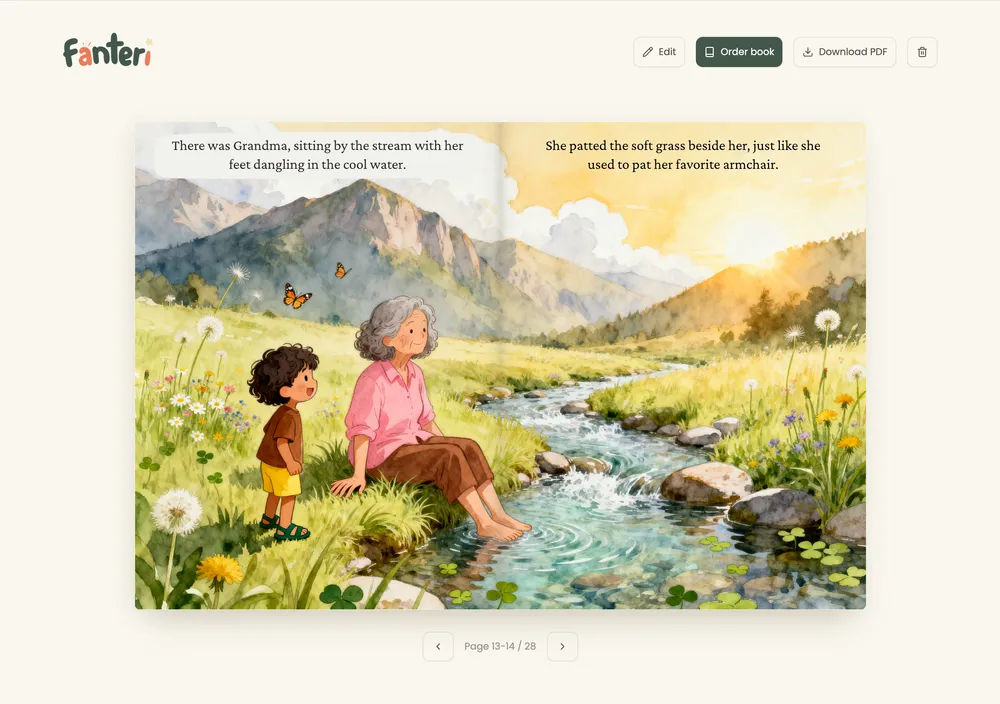
Fanteri offers three illustration styles (watercolor, hand-drawn, and 3D) — fewer than some competitors, but with a deliberate focus on quality over quantity. The image model is chosen to produce illustrations that feel like real art, not typical AI-generated images. The result is warm, detailed illustrations with a handcrafted quality that holds up throughout the entire book.
Four age groups (0—2, 3—5, 5—7, 7—9) ensure that language, complexity, and text volume actually suit the child. Full text editing and the ability to regenerate illustrations give you control over the result. The entire process takes under 10 minutes.
Books can be read digitally, downloaded as PDF, or ordered as a printed book — both softcover and hardcover.
Worth knowing
Fewer illustration styles than many competitors (3 vs. up to 60+), and no photo-based personalization — characters are described with text, not images. The first book is discounted. Subscriptions cost €13.99/month for 4 books.
Google Gemini Storybook
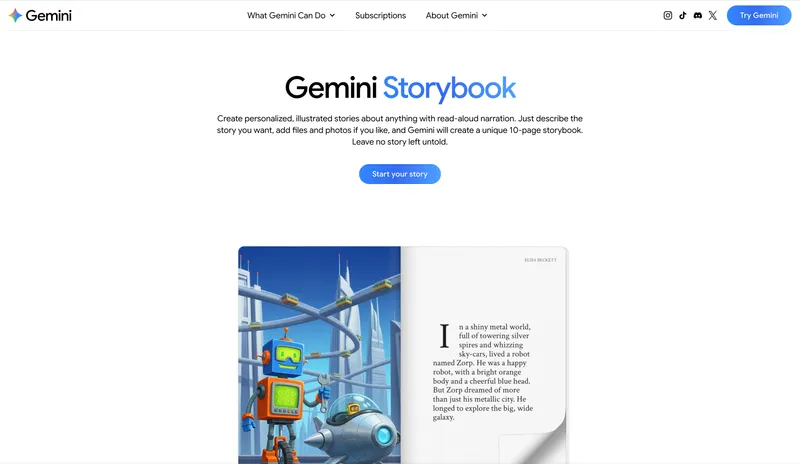
Google launched Gemini Storybook in 2025, and it's the biggest player in the market from a technology standpoint. You describe the story you want, and Gemini creates an illustrated book with 10 pages.
What they're good at
The service is free to use, but the free version has daily limits on the number of stories you can create. For unlimited use, you need Gemini Advanced ($19.99/month via Google One AI Premium). You describe the illustration style you want in free text — for example "watercolor" or "pixel art" — and Gemini tries to match it. You can also upload images and documents as a starting point for the story.
Worth knowing
Gemini Storybook is a general-purpose AI tool with a storybook feature — not a dedicated children's book platform. Books are 10 pages, shorter than most other services. You can't edit text directly — you can only ask Gemini to change it through new instructions. There's no dedicated print service or PDF export, but you can print via your browser. Character consistency between pages varies noticeably — the child can look completely different from page to page. Illustrations also have a recognizable "Gemini look" regardless of which style you choose.
Magical Children's Book
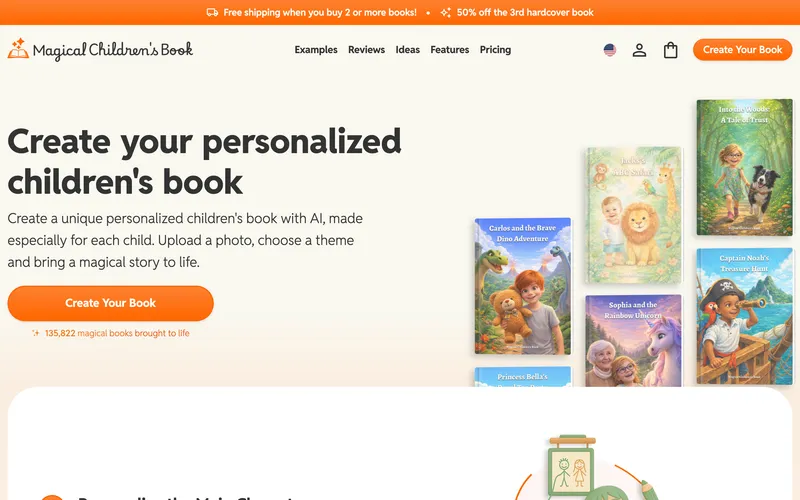
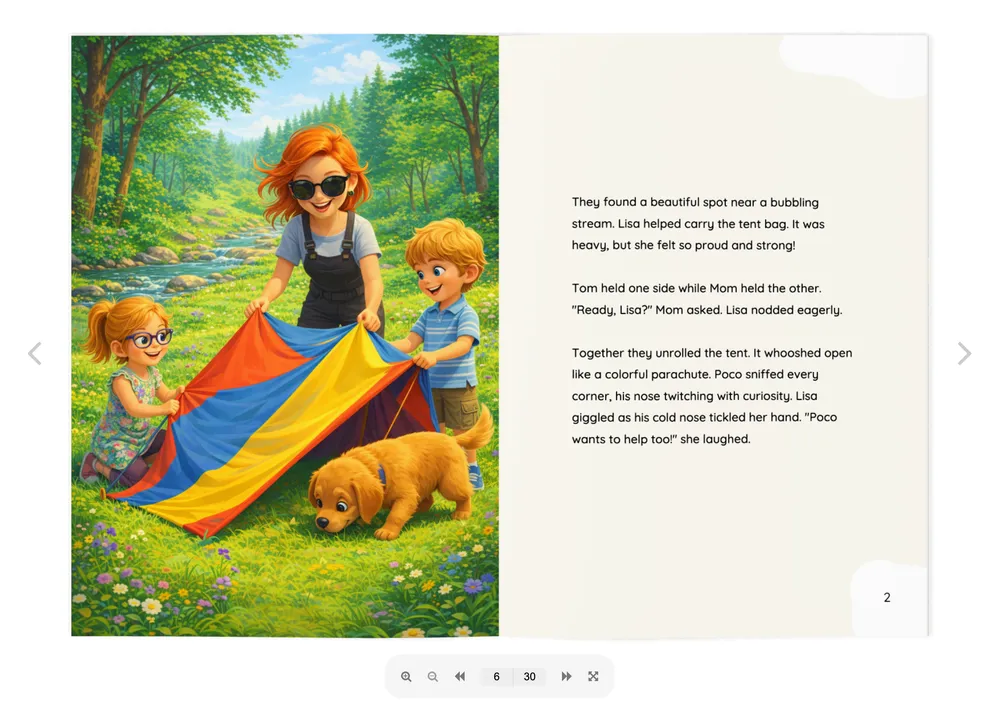
Magical Children's Book lets you upload a photo of your child, choose a theme, and get an AI-generated book where your child is the main character — with their face in the illustrations.
What they're good at
Photo-based personalization is their thing. Your child appears as an illustrated version of themselves, which can give a real wow effect. You can have up to 5 characters in the same story, including siblings and pets. Books come in a gorgeous A4 format with 24 pages, with 12 illustration styles — from watercolor and gouache to 3D animation and claymation.
Worth knowing
The service is available in 22 European countries plus the US and UK — but not Norway. Denmark and Sweden are included. A digital book costs about $7.99, hardcover about $34.99. It's single purchases only — no subscription model. Some users report delivery issues and slow customer service.
Childbook.ai
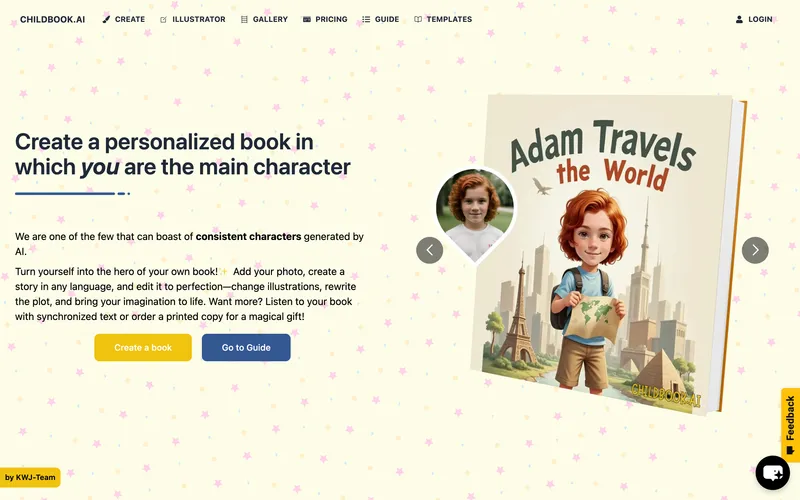
Childbook.ai is an established AI children's book platform with broad functionality and Canva integration.
What they're good at
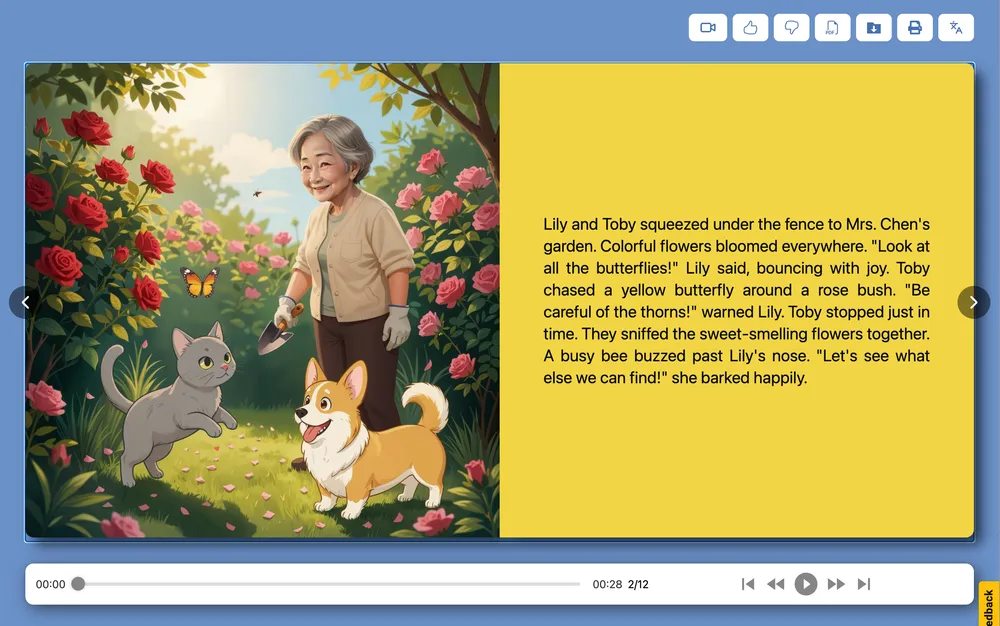
They've come a long way in solving one of the hardest problems in AI illustration: consistent characters throughout the book. The child mostly looks the same from page to page, which not everyone manages — though consistency can vary with more characters. They also offer Canva integration for further editing. Prices start low — from about $2.50 for a single book.
Worth knowing
No free version — the cheapest option is a single book from $2.50. Subscriptions start at $15/month (Hobby, 20 books) and $24/month (Premium, 50 books). The platform is primarily aimed at those who want to create many books, such as self-publishing authors. Some users report AI artifacts in illustrations (extra fingers, arms).
Lullaby.ink
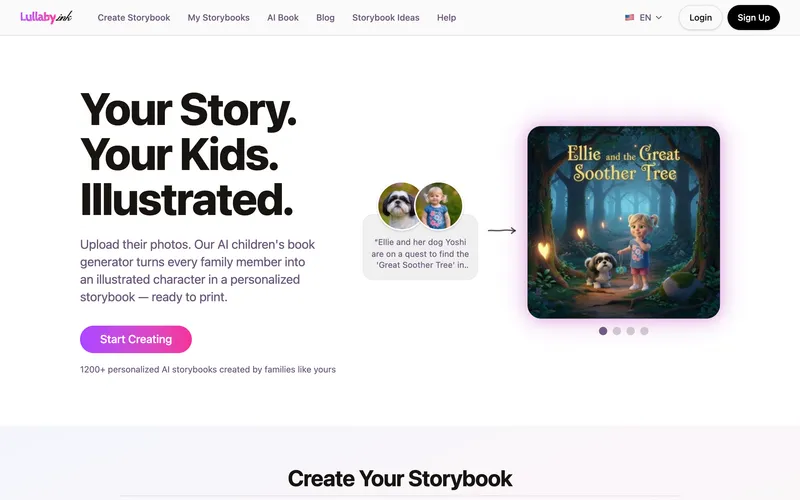
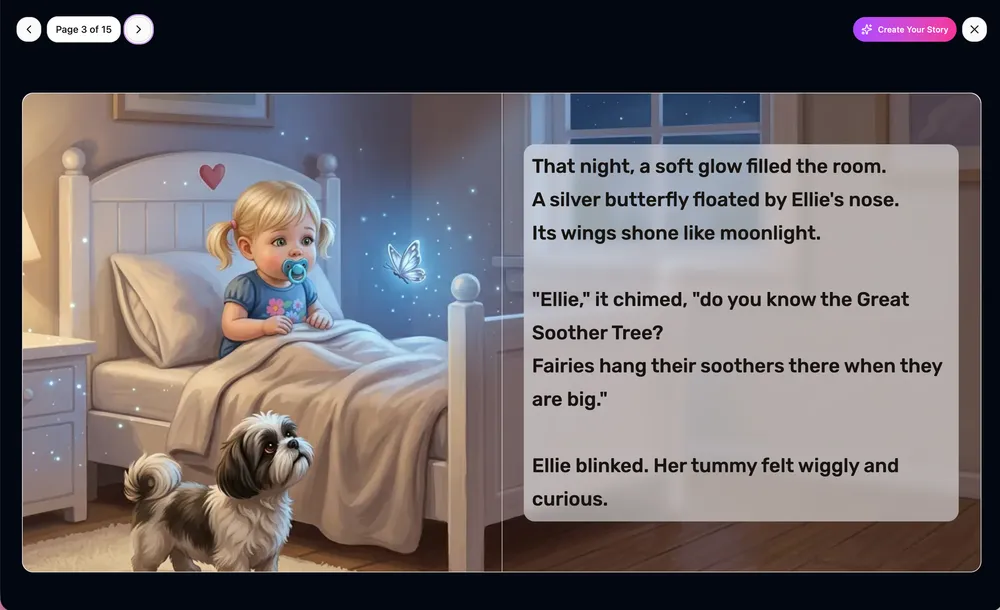
Lullaby.ink is all about deeper personalization through photo-to-illustration technology. You upload photos of family members, and the AI transforms them into illustrated characters.
What they're good at
They have an impressive 7 illustration styles — from "Pixar Adventure" to "Dreamy Watercolor" and "Claymation". Characters get clothing and appearance that fits the story (what they call "story-aware outfits"), and you can have up to 3 family members in the same book. The book is ready in 2—5 minutes, and you can choose between softcover, hardcover, or layflat print.
Worth knowing
Photo-based personalization means quality depends on the photos you upload. The service is in English, and available for delivery in a limited number of countries.
ReadKidz
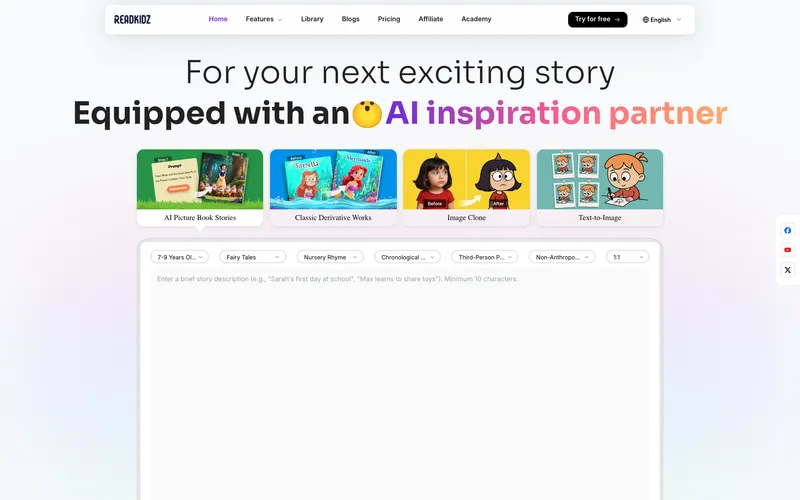
ReadKidz is a multimedia platform aimed at creators and self-publishing authors. You don't just make children's books — you can also generate animated videos, songs, and audiobooks from the same project.
What they're good at
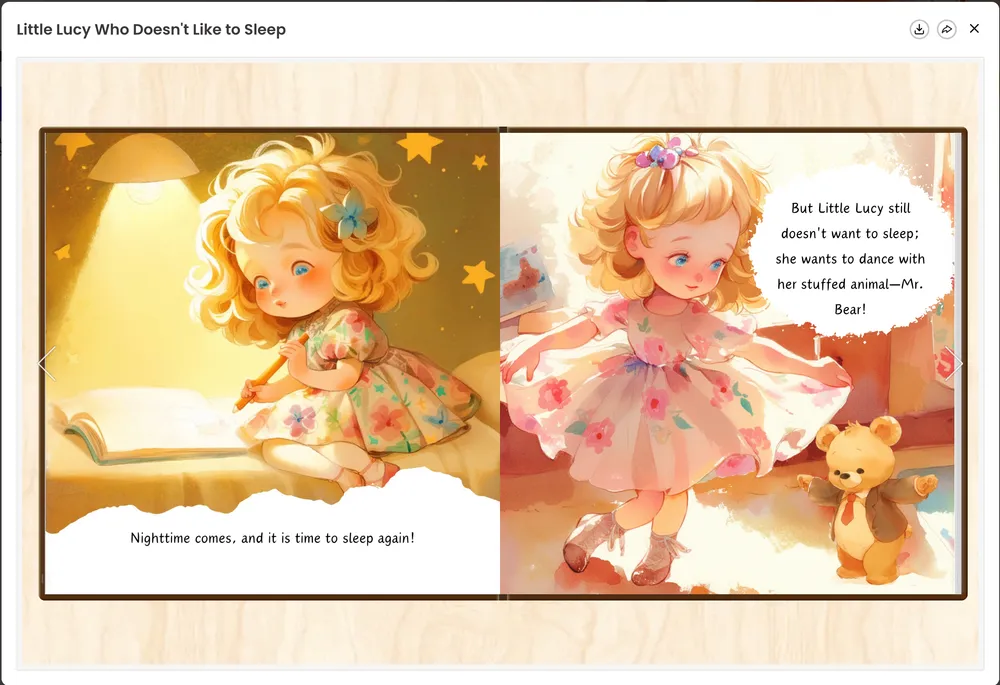
Over 100 illustration styles give you enormous creative freedom. The "Chat PS" feature lets you edit illustrations with natural language — for example, "make the helmet silver" or "add a moon to the sky." Character Mat helps maintain visual consistency, and you can export books directly to Amazon KDP for publishing.
Worth knowing
No direct print-on-demand — you need to upload to Amazon KDP yourself for physical books. Credit-based pricing makes it hard to predict total cost. The platform has a steeper learning curve than the more parent-focused services, and is primarily in English. Trustpilot reviews mention technical issues and difficult refund terms.
Who is each service best for?
There's no single service that's best for everyone. Here are some simple rules of thumb:
- Want to try without paying? Gemini Storybook has a free version that works right in your browser.
- Want to see your child's face in the illustrations? Magical Children's Book or Lullaby.ink use photo-based technology.
- Want to create many books for publishing? Childbook.ai has Canva integration and high volume.
- Want to create books, videos, and audiobooks? ReadKidz is a multimedia platform for creators.
- Want full-bleed illustrations, age-appropriate content, and full control? Fanteri offers creative freedom and printed books.
How do the services compare?
| Fanteri | Gemini Storybook | Magical Children's Book | Childbook.ai | Lullaby.ink | ReadKidz | |
|---|---|---|---|---|---|---|
| Personalization | Full creative freedom (story, character, plot) | Free text description | Photo-based (child's face) | Description or photo | Photo-based (up to 3 people) | Description + reference image |
| Illustration styles | 3 (watercolor, hand-drawn, 3D) | Free-text prompt | 12 styles | Various AI styles | 7 styles | 100+ styles |
| Illustration layout | Full-bleed spreads | Single page | Single page | Single page | Single page | Spreads or single page |
| Age adaptation | 4 age groups (0—2, 3—5, 5—7, 7—9) | General | 4 age groups (0—2, 3—5, 6—9, 10+) | 4 age groups (3—5, 5—8, 9—11, 12+) | General | Freeform age input |
| Languages | 17 languages (Norwegian, English, Swedish, Danish, German, French, Spanish etc.) | 45+ languages | 22 countries (not Norway) | Any language | English | Primarily English |
| Physical book | Softcover + hardcover | No (browser print only) | Hardcover (A4) | Softcover/hardcover | Softcover, hardcover, layflat | Via Amazon KDP (manual) |
| Editability | Full text editing + regeneration | Indirect (via instructions) | Text + illustrations | Canva integration | Text editing | Full + Chat PS (AI editing) |
| First book | Discounted intro price | Free (daily limits) | Approx. $7.99 digital | From $2.50 | From $5 digital | Credit-based (from $3) |
| Subscription | €13.99/mo (4 books) | Gemini Advanced ($19.99/mo) | No | From $15/mo | No | From $10/mo |
A word about privacy and children's photos
Some of the services in this overview use photo-based personalization — you upload a photo of your child, and the AI uses it to generate illustrations. It gives a wow effect, but it's worth considering what that involves.
Facial images are classified as biometric data under GDPR, and children's personal data has extra protection. When you upload a photo to an AI service, it's processed by a model — and it's not always clear how the data is stored, or whether it's used to train the model further. Most reputable services have clear terms about this, but it's wise to read them.
Another important thing: You can't upload photos of other people's children without consent from their parents. The same applies to adults — grandma, aunt, or a friend has to say yes before you send a photo of them to an AI service. It's easy to forget when you're just trying to make a cozy family book, but legally, parents are responsible for each individual child, and each person owns their own image.
This doesn't mean photo-based services are unsafe — but it's a decision parents should make consciously, not something that just happens in the background without you thinking about it.
Fanteri uses text descriptions instead of images, avoiding the issue entirely.
The best children's books are the ones about your child, told the way that suits your family. And there's room for everyone who's working to make reading time a little more magical — regardless of which service you choose.
Frequently asked questions
Which AI children's book service is best?
It depends on what you're looking for. Fanteri is best if you want full-bleed illustrations, full creative control, and books in Scandinavian languages. Magical Children's Book and Lullaby.ink are good options if you want to see your child's face in the illustrations. Gemini Storybook is free and fast but doesn't offer printed books.
Which AI children's book services support multiple languages?
Fanteri supports 17 languages. Gemini Storybook supports over 45 languages. Childbook.ai generates stories in any language. Magical Children's Book supports 25 languages but ships to 22 European countries plus the US and UK. Lullaby.ink, ReadKidz, and LoveToRead.ai are primarily in English.
Is it safe to upload photos of children to AI services?
Facial images are classified as biometric data under GDPR, and children's personal data has extra protection. Reputable services have clear terms about this, but it's wise to read them. Also remember that you cannot upload photos of other people's children without consent from their parents. Fanteri uses text descriptions instead of photos, avoiding the issue entirely.
How much do personalized AI children's books cost?
Prices vary widely. Fanteri offers a discounted intro price for your first book. Childbook.ai starts at $2.50. Magical Children's Book costs about $7.99 digital and $34.99 hardcover. Lullaby.ink starts at $5 digital. Gemini Storybook is free (with daily limits).
What's the difference between Fanteri and other AI children's book services?
The main difference is that Fanteri uses full-bleed spreads where text is placed on top of one large, continuous illustration -- like a real picture book. Most other services have an image on one page and text on the other. Fanteri also supports more age groups, full text editing, and 17 languages.
Can I order printed books from these services?
Fanteri, Magical Children's Book, Childbook.ai, and Lullaby.ink offer professional printing. ReadKidz requires you to upload to Amazon KDP yourself. Gemini Storybook only offers digital books (you can print via your browser).